James Hardie Junior ADU Conversion: The Santa Clarita Owner’s Guide
Junior ADU conversion parts for James Hardie siding systems in Santa Clarita typically run $1,450 to $3,200 installed, depending on whether we’re replacing a section of HardiePlank lap siding, re-flashing a transition, or rebuilding a soffit corner that’s been pulling moisture. Most Santa Clarita homeowners discover the problem the same way: a corner bead starts swelling, paint bubbles along the bottom edge, or a gap opens where the junior unit meets the main house. We stock the common James Hardie trim profiles, flashing, and fasteners on our trucks, so most conversions are completed in a single visit.
What most people don’t realize is that a junior ADU conversion in Santa Clarita isn’t just about swapping a board. The dry heat and occasional hard rain we get here mean the transition points between the main structure and the junior unit are doing more work than the siding itself. When that transition fails, water finds its way in slow enough that you don’t see it until the paint tells you something’s wrong.
Which James Hardie Models This Applies To
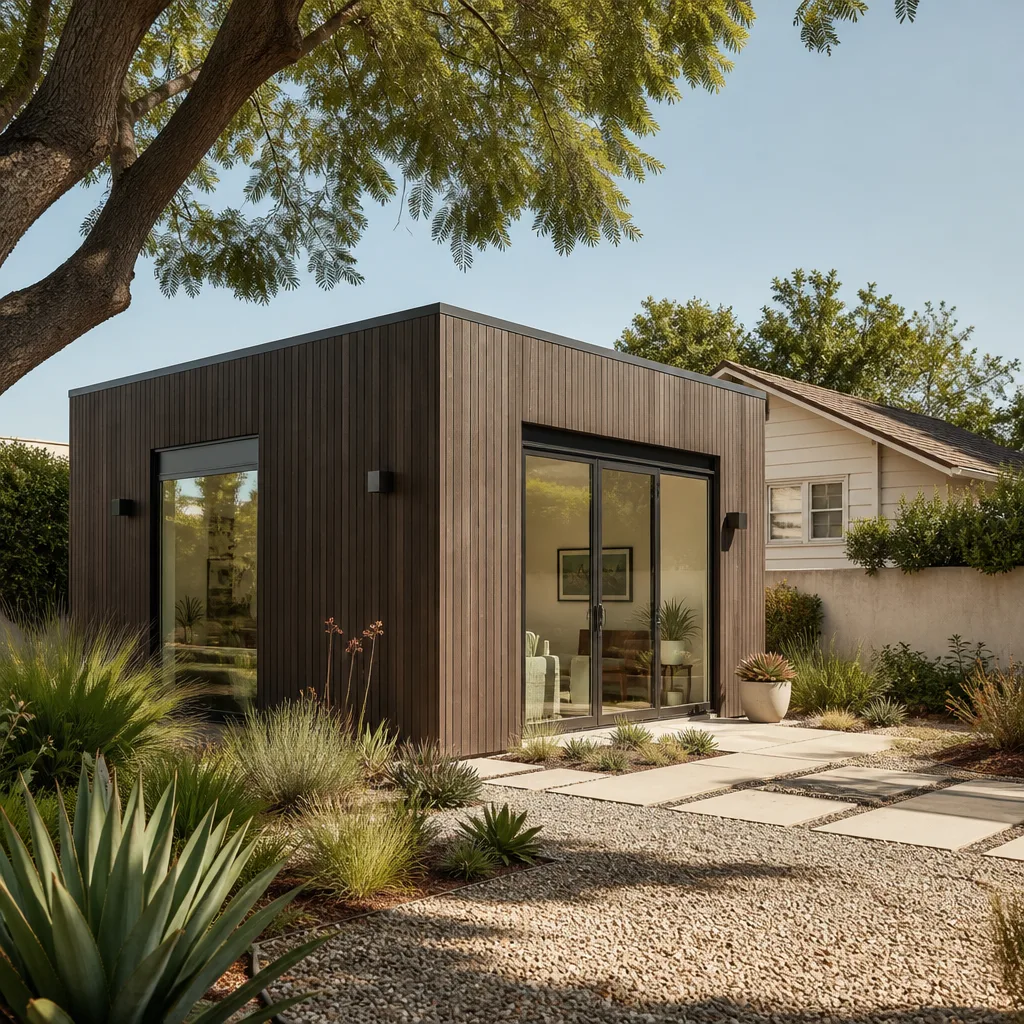
If your junior ADU was built with James Hardie products, you’re almost certainly dealing with one of three lines: HardiePlank lap siding (the 5/4″ or 8-1/4″ exposure profiles), HardiePanel vertical siding, or HardieTrim boards in the 1×4 and 5/4×4 dimensions. The part that fails first is rarely the siding itself. It’s the trim, the flashing, or the joint where two different materials meet.
Here’s the compatibility gotcha most Santa Clarita homeowners run into: James Hardie changed their trim board dimensions in 2019, moving from a true 1″ thickness to a 7/8″ nominal on some profiles. If your junior unit was built before that, a standard off-the-shelf replacement trim board from a big box store won’t sit flush with the existing siding plane. You either need a ripped-down replacement or the newer profile with a shim detail. We keep both on hand because we’ve seen this exact mismatch on units in Valencia, Saugus, and Canyon Country.
For the OEM versus aftermarket question: James Hardie’s own trim and siding are fiber cement, and aftermarket fiber cement equivalents exist, but they don’t carry the same 30-year limited warranty transfer. We install genuine James Hardie parts when the unit’s existing warranty matters to the family. When the homeowner just needs a solid repair on an out-of-warranty unit, we’ll use quality aftermarket fiber cement or, in dry-covered applications, a PVC trim that holds up well in the Santa Clarita Valley’s UV conditions.
Signs Your James Hardie Junior ADU Conversion Is Failing
- Bottom-edge swelling on HardiePlank lap siding. This means water is wicking up from grade or from a hardscape surface that’s splashing back against the wall. We see it most often on units where a concrete walkway was poured too close to the exterior face. The fix is correcting clearance, not just replacing boards.
- Corner trim pulling away at the seam. Fiber cement expands and contracts with temperature swings, and Santa Clarita gets a 40-degree spread between summer afternoons and winter nights. When the original installer didn’t leave a proper expansion gap, the trim buckles at the miters.
- Caulk cracking repeatedly at the transition between the main house and the junior unit. That joint is moving more than the rest of the structure. Caulk alone was never going to hold it. The right fix is a proper flashing detail with a backer rod, then sealant.
- Dark staining radiating from fastener heads. That’s galvanic corrosion. Somebody used the wrong fasteners, and the metal is bleeding into the fiber cement. Post-2019 Hardie products require stainless steel or hot-dipped galvanized fasters, and older units often had electro-galvanized nails that fail faster in our valley’s occasional damp winter mornings.
- Bubbling paint that reappears months after repainting. Moisture is trapped behind the siding. Repainting without fixing the drainage plane is just adding a lid to a pot that’s already boiling.
Replacement Cost & What’s Included
For Santa Clarita junior ADU conversions, most James Hardie repairs fall into three bands. A single trim board or short siding run replacement runs $250 to $600 installed. A full side re-siding with new flashing at all transitions typically runs $1,600 to $2,800. A complete conversion that includes correcting drainage, rebuilding a corner, and repainting the affected elevation runs $3,000 to $4,500.
Here’s what’s included on every one of those jobs: the parts, the labor, the flashing, the sealant, the fasteners, and the cleanup. We write the price before we touch anything, and it does not change unless we open the wall and find something structural that nobody could have predicted. Even then, we stop and show you before we spend another dollar.
The work itself is covered by our 365-Day Done Right Promise. If it fails within a year because of something we did or a part we installed, we make it right. We also honor the James Hardie manufacturer warranty on genuine parts, which matters if you ever sell the property.
DIY or Call Us?
James Hardie fiber cement is heavy, brittle when cut incorrectly, and produces silica dust when cut with a circular saw. That dust is a respiratory hazard. We use shears and dust collection on our cuts, and we wear proper PPE. If you’re replacing one short piece of trim and you have the right blade and a dust mask, it’s a reasonable Saturday project.
The point where DIY goes wrong on junior ADU conversions is the flashing. Most people don’t know how to sequence the layers correctly, and that’s exactly where leaks happen. If you’re dealing with a transition between structures, a corner, or anything involving the roof line, call us. Ben Ortega and the crew will walk you through what we see, what it costs, and whether it’s something you can handle yourself. Call (661) 362-8059.
FAQs
James Hardie fiber cement carries a 30-year limited warranty, and in Santa Clarita’s dry climate, the siding itself often lasts longer than that – it’s the flashing, caulk, and fasteners that fail in the 10 to 15 year range, not the boards. If you’re seeing failures before year 10, it’s almost always an installation issue at the transitions, not a product issue. Call (661) 362-8059 and we’ll tell you what we’re looking at.
Yes, in most cases a partial repair is completely viable, especially on a color-matched painted surface where we can replace individual boards and reflash the problem joint. The exception is when water has been getting behind the siding long enough that the sheathing underneath is compromised – we’ll know within 30 minutes of opening it up.
A single trim board or short siding run takes 2 to 4 hours. A full side with reflashing takes one to two days. A complete conversion with drainage correction takes three to five working days, depending on whether we’re repainting. Before any of that, we give you a written price and a schedule, and we hold to both.
We stock the common HardiePlank profiles, HardieTrim boards in both pre-2019 and post-2019 thicknesses, flashing, sealant, and stainless fasteners on our trucks. Less common colors and profiles are ordered from James Hardie distributors and arrive within three to five business days in Santa Clarita. If you’d like, we can also talk through alternatives from Abodu, Cover, or Dvele if the unit’s envelope needs more than a patch.
Written by Ben Ortega, Owner, Seedling ADU Santa Clarita at Seedling ADU Santa Clarita, serving Santa Clarita and nearby areas.